

Single Bottle

Thank you! Your submission has been received!
Oops! Something went wrong while submitting the form.
By entering this site, you acknowledge that you are at least 21 years of age. If you are not, feel free to explore our non-alcoholic products.
Everything you need to know about us and our wines.
General
Union Wine Company is a family-owned, B Corp certified winery based in Oregon, founded by Ryan Harms in 2005. We make wine for real life, the kind you crack open on a Tuesday, take hiking, or bring to a potluck without a second thought.
Our portfolio includes Underwood, Amity Vineyards, Kings Ridge, Christopher Michael Wines, Yosemite Cellars, and Alchemist. One thing ties them all together: wine should be approachable, not precious.
We don't have a public tasting room at this time. We do pop-up at events and festivals periodically, follow us on Instagram or join our email list to find out where we'll be next.
Sign up for our email newsletter and follow us on Instagram and TikTok. We share new releases, behind-the-scenes content, and the occasional recipe.
The Wines
Yes. All of our wines are vegan. We do not use animal-derived fining agents in our production process.
Yes. Wine is naturally gluten-free, and our wines are made from grapes with no gluten-containing ingredients.
Yes — like most wines, ours contain sulfites. Sulfites are naturally occurring compounds that also serve as a preservative. Federal law requires any wine with more than 10 parts per million to carry a 'contains sulfites' statement on the label.
Our wines aren't sulfite-free, but they're well within normal ranges. If you have a known sensitivity, consult your doctor. True sulfite allergies are relatively uncommon, and many people who think they react to sulfites may be reacting to other compounds in wine.
ABV (alcohol by volume) is printed on every label and product page. Our still wines generally fall between 12-14% ABV. Sparkling wines tend to be a bit lower. Our Non-Alc Rosé Bubbles is less than 0.5% ABV.
Underwood Non-Alc Rosé Bubbles is a sparkling rosé with less than 0.5% ABV, made from real wine grapes and dealcoholized using a gentle process that preserves flavor. It's dry, lightly effervescent, and designed to stand on its own, not as an afterthought.
Wine is an agricultural product — every harvest is different. Cooler years tend to produce brighter, more acidic wines. Warmer years lean rounder and riper. That variation isn't a defect; it's the whole point.
If you have questions about a specific vintage change, reach out and we're happy to walk you through what made that year distinctive.
Please email us at info@unionwinecompany.com with the product name, vintage, where you purchased it, and a description of what you experienced. We take quality seriously and will follow up promptly.
Still wines should be stored on their side in a cool, dark place, away from direct light and temperature swings. A consistent 55-65°F is ideal, though most home refrigerators work fine for short-term storage.
Canned wines are best stored upright and kept out of extreme heat. Unlike bottles, the can seal doesn't benefit from contact with the wine, so no need to lay them down.
Our sparkling wines are best enjoyed within 1-2 years of the packaging date. The packaging date is printed on the bottom of your can.
White and sparkling wines: 45-50°F (about 30-45 minutes in the fridge). Light reds like Pinot Noir: 55-60°F (slightly chilled is great, especially in summer). Fuller reds: 60-65°F.
For canned wine, whatever gets it cold fastest. Cans chill significantly faster than bottles.
All About the Cans
Because they make sense. Cans chill faster, weigh less, travel better, and go where glass can't; the trail, the boat, the concert, the beach. They protect wine from light and oxygen better than any bottle, and they're infinitely recyclable.
Yes. The same wine that goes in our bottles goes in our cans. No different recipe, no shortcuts, no compromises, just wine in a lighter, more versatile package.
If you really want the full aromatic experience, you might want to pour it into an open vessel. It can be tough to get aroma volatilization through the can hole. But otherwise it's the same wine!
Our canned wines come in 355ml cans, which is about half a standard 750ml bottle, or just over two 5 oz pours. We also offer 250ml cans.
There are two lines of text on the bottom of each can. The top line is the vintage year — the year the grapes were harvested. The second line is the packaging date, which tells you when the wine was canned.
Both are fine. Drinking from the can is convenient and keeps things cold. Pouring into a glass opens up the aromas, especially for still wines. For sparkling wines, staying in the can helps preserve the bubbles. You do you.
Yes. Aluminum is one of the most recyclable materials on earth. It can be recycled infinitely without losing quality, and most areas accept 355ml cans in curbside recycling.
Best answer: drink it. Opened wine, especially sparkling wine, is best enjoyed right away. If you do have leftovers, seal the can with a can stopper or transfer to a small airtight container and refrigerate. Drink within a day or two.
Online Store & Shipping
A few factors: wine is heavy and fragile, packaging must meet alcohol carrier standards, and federal law requires an adult signature at delivery, which carriers charge a surcharge for. It adds up.
We try to keep shipping costs as reasonable as possible and offer free shipping promotions regularly. Signing up for our email list is the best way to hear about them.
Yes. Alcohol shipments require an adult signature (someone 21+) at delivery — the carrier will check ID. Another adult can sign on your behalf, so shipping to an office or a building with a doorman works fine.
If you miss a delivery attempt, use your tracking link to schedule a redelivery or redirect to a carrier pickup location.
No. Alcohol shipments can only be delivered to a residential or commercial street address.
Orders typically ship within 1-3 business days of being placed. Transit time depends on your location, but most orders arrive within 3-7 business days. You'll receive a tracking link as soon as your order ships.
Yes. Enter the recipient's address at checkout. Keep in mind that someone 21+ must be available to sign for the delivery, so a home address works better than an apartment building without a doorman, and a PO Box won't work.
Gift cards are also available in our online store if you'd rather let someone pick their own wines.
Yes. Gift cards are available in our online store and never expire.
Contact us at info@unionwinecompany.com as soon as possible. If your order hasn't shipped yet, we can update the address. Once it's in transit, rerouting may be possible but typically involves a carrier fee, and we can't reroute across state lines.
We're sorry about that. Email us at info@unionwinecompany.com within 7 days of delivery with your order number and a photo of the damage and we'll make it right.
Because of alcohol shipping regulations, we can't accept returns on shipped wine. If there's a quality issue or your order was damaged in transit, reach out and we'll take care of you.
To cancel an order that hasn't shipped yet, contact us at info@unionwinecompany.com as quickly as possible and we'll do our best.
Email us at info@unionwinecompany.com and someone on our team will get back to you. We're a small team, so responses may take a couple of business days, but we read everything.
Oregon Wine
Oregon is best known for Pinot Noir. The cool, wet climate of the Willamette Valley produces Pinot Noirs with bright acidity, earthy depth, and red fruit character that sit closer to Burgundy than to California. It is a style that rewards attention but does not demand it.
Beyond Pinot Noir, Oregon is also known for Pinot Gris, Chardonnay, and Riesling. The state has a long tradition of farming with restraint and that philosophy shows up across the portfolio.
Climate is the biggest factor. Oregon's growing season is cooler and longer, which means grapes develop flavor slowly and retain natural acidity. The result is wines that tend to be lower in alcohol, higher in acidity, and more food-friendly than many California counterparts.
Oregon winemakers also tend to work at smaller scale, with a focus on single-variety, single-vineyard wines. That ethos is part of why we make wine here.
Willamette Valley is Oregon's premier wine region, located southwest of Portland. It's one of the few places in the world with the right combination of latitude, soil, and maritime climate to grow world-class Pinot Noir.
Willamette Valley Pinot Noirs are typically characterized by red cherry, raspberry, and cranberry fruit, earthy and forest floor notes, firm but refined tannins, and bright natural acidity that makes them excellent with food.
All of our Pinot Noir from Underwood to Amity Vineyards to Kings Ridge comes from this region.
Pinot Noir and Pacific salmon is one of the great regional pairings in American food and wine. The acidity in Oregon Pinot cuts through the richness of the fish without overpowering it. It works with grilled, roasted, or cedar-planked preparations.
Pinot Gris is the go-to for shellfish: Dungeness crab, oysters, clams. Chardonnay works well with halibut and anything with a butter or cream preparation. If you're doing a classic PNW spread with charcuterie, smoked fish, and aged cheese, a sparkling wine like our Bubbles holds its own across everything on the board.
Finding the Right Wine
Single Bottle
Single Bottle

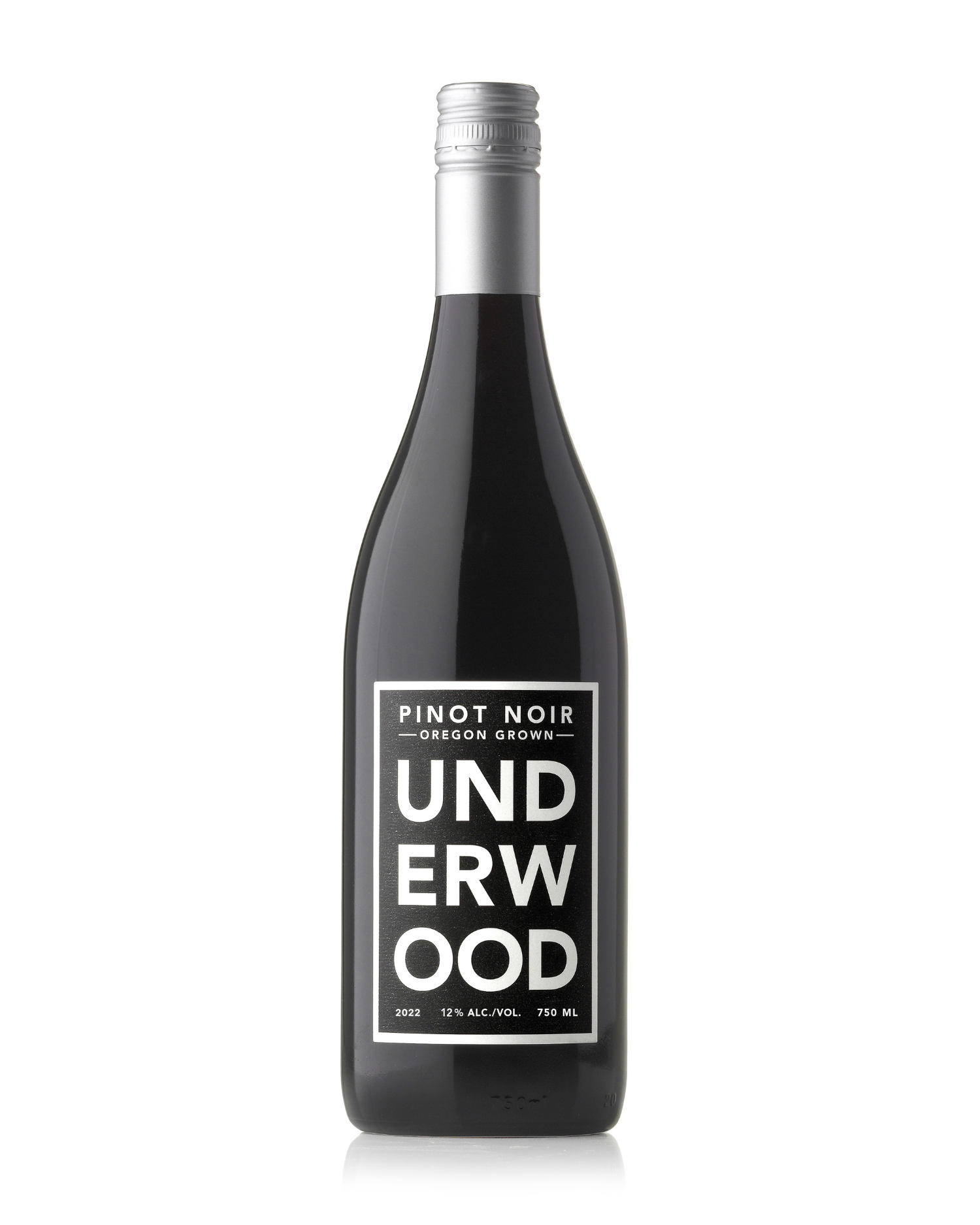
Underwood Pinot Noir. We set out to make a Oregon Pinot Noir that does not ask you to choose between quality and price. It's real wine from a real place, made by people who take it seriously, at a price that makes it easy to open whenever.
Start with something you're already curious about. If you like bubbles, try Underwood Bubbles or Rose Bubbles. They're dry, food-friendly, and approachable without being sweet. If you want a red, Underwood Pinot Noir is a good entry point: lighter-bodied, smooth, and forgiving with food pairings.
Cans are also a low-commitment way to try a wine before buying a whole bottle. We make all of our most popular wines in 355ml cans.
Something crowd-pleasing, easy to transport, and not so precious you'll be worried about it. Underwood cans check all three boxes. They travel well, chill fast, and don't require a corkscrew or glassware. Rose and Pinot Gris tend to be the most universally liked at a table of mixed tastes.
If you're bringing a bottle, and want to impress, try one of our Amity Vineyards wines.
Pinot Noir with pizza is underrated. The acidity and light tannins work with tomato sauce in the same way a classic Italian red does. For burgers, Pinot Noir still works, or try a Pinot Gris if you want something lighter.
For backyard or outdoor settings, cans are the obvious move. They're practical, they don't break, and Underwood Rose holds up in the sun.
Canned Wine: Common Questions
Yes, if it starts as good wine. The can is just a container. What matters is what's inside it, and we put the same wine in our cans that goes in our bottles. No different blend, no shortcuts.
Canned wine has a reputation problem that's mostly a legacy of the early days, when the format was treated as a dumping ground for leftover juice. That's not what we do. Underwood started as a canned wine brand because we genuinely believed the format made sense, not because it was cheaper.
We have heard some say that they have issues with canned wine not consumed within 6 months to a year, but that is not our experience. Because the can protects the wine from light and there is zero oxygen ingress, if the can was sealed correctly, we view the can as a time capsule. We've opened cans from our inventory that are 5, 6, 7 years old, and they still taste fresh and vibrant!
Store in a cool, dark place away from heat and direct light.
Ours is comparable. A 355ml can is roughly half a bottle, priced accordingly. The format is not a budget play. It's a format that makes sense for how people actually drink wine outside of a formal setting.
Buying cans can also make it easier to control how much you open at once, which reduces waste if you don't want a full bottle.
Not inherently. Quality is determined by the wine inside, not the container. Cans actually offer real advantages: they block light completely, seal perfectly against oxygen, and are far more portable than glass.
Our Underwood Pinot Noir has been poured at James Beard events and won blind tastings against bottled wines at the same price point. The can doesn't change what's inside.
Non-Alcoholic Wine
It depends on the product. A lot of non-alc wine on the market is thin, overly sweet, and grape-juice-adjacent. We made Underwood Non-Alc Rose Bubbles because we were not satisfied with what existed.
Ours starts as real wine made from real grapes, then goes through a gentle dealcoholization process that removes the alcohol while preserving as much of the flavor and structure as possible. It's dry, effervescent, and meant to stand on its own.
4-Pack

Underwood Non-Alc Rose Bubbles is less than 0.5% alc./vol., which puts it in the same category as kombucha and most ripe fruit juices. It's a great option for anyone who wants to be part of a toast or have something interesting in their glass without the alcohol.
If you're pregnant, always check with your doctor about what's right for you. We can only tell you what's in the can.
Dealcoholized wine starts as regular wine. Grapes are harvested, fermented, and vinified the same way. Alcohol is then removed using one of several techniques, most commonly vacuum distillation or spinning cone technology, which use low heat to evaporate and remove ethanol while minimizing impact on flavor.
The result retains much of the aroma, acidity, and body of the original wine, with alcohol reduced to less than 0.5% alc./vol. It's a fundamentally different product from grape juice, which was never wine to begin with.
Sustainability and Values
Union Wine Company is one of a small number of wineries in the United States to hold B Corp certification. B Corp is awarded by B Lab and requires companies to meet rigorous standards across five categories: governance, workers, community, environment, and customers.
Our brands, including Underwood, Amity Vineyards, Kings Ridge, Christopher Michael Wines, Yosemite Cellars, and Alchemist, all operate under the Union Wine Company umbrella and are covered by that certification.
Sustainability in wine is a spectrum, and anyone claiming to be the single most sustainable brand is probably oversimplifying. What we can tell you is what we actually do: B Corp certification, LIVE certified winery practices, a can-forward format that reduces packaging weight and carbon footprint, and a commitment to transparency in how we operate.
Cans are worth mentioning specifically. Aluminum is infinitely recyclable and significantly lighter than glass, which reduces transportation emissions at scale.
Glass bottles are heavy, fragile, and energy-intensive to produce and transport. A case of canned wine weighs a fraction of a case of bottles, which means fewer emissions per unit shipped or driven to the store.
Aluminum is also one of the most efficiently recycled materials on earth. It can be recycled infinitely without loss of quality, and the recycling process uses about 95% less energy than producing new aluminum.
We were early on canned wine partly because it made sense for how people drink outdoors and on the go. The sustainability case has always been part of it too.
.png)