Are you 21 years or older?
By entering this site, you acknowledge that you are at least 21 years of age. If you are not, feel free to explore our non-alcoholic products.
By entering this site, you acknowledge that you are at least 21 years of age. If you are not, feel free to explore our non-alcoholic products.

There's nothing easy about walking a block one last time, knowing it's coming out. These were some of the oldest vines we farm. Pinot Blanc, planted in 1971 and 1974, part of the original vineyard Myron Redford put in as he built what became Amity. Fifty years of gnarled old trunks, and for most of that time their fruit went into our estate Pinot Blanc. But phylloxera had gotten into the block. It's a root-feeding pest that has wrecked vineyards all over the world, and once it's in, the vines aren't coming back. So we made the call and pulled them.
Usually what happens next is you pile the wood up and burn it. An old block is a lot of wood, and for most vineyards an open burn is just the practical way to be rid of it.
We were in a position to do something else with it. Biochar isn't a miracle, and I won't pretend it is. But it let us treat what the block left behind as something worth keeping.
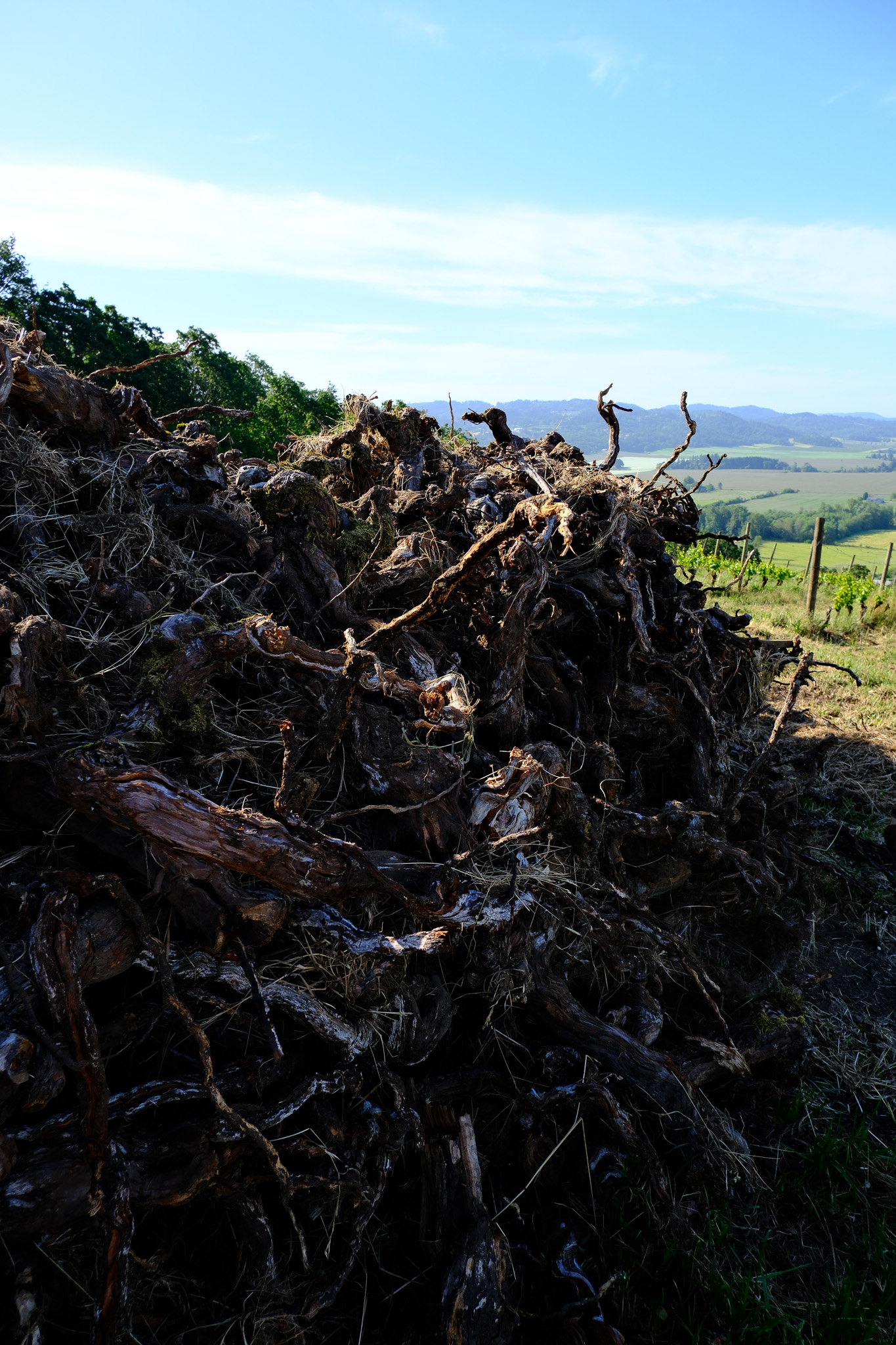
Burning works fine as disposal, and I don't want to pretend otherwise. Whatever might be living in that wood, the fire takes care of it. But so does making biochar, so sanitation wasn't really the deciding factor for us. Carbon was. Every one of those trunks is decades of carbon the vine pulled out of the air and laid down as wood. Burn it in the open and almost all of that goes back up in an afternoon, smoke and air-quality problems included. You spend fifty years growing something, then you're left with a pile of ash.
We kept coming back to the same question. What if the vines still had something left to give?
Biochar is charred organic material. In our case, our own vine wood. You make it through pyrolysis, which just means heating the wood hot with very little oxygen so it chars instead of burning up. Think of it like charcoal, except the point isn't to burn it later. The point is to put it in the ground and leave it there. Starved of oxygen, the wood breaks down instead of turning to ash, and what you're left with is a stable, porous form of carbon that can sit in the soil for decades or centuries, sometimes a lot longer, depending on conditions. That's the real difference from an open burn. Burning leaves only a few percent of the wood's carbon behind. Pyrolysis keeps something closer to half, though that depends on the wood and how it's cooked.
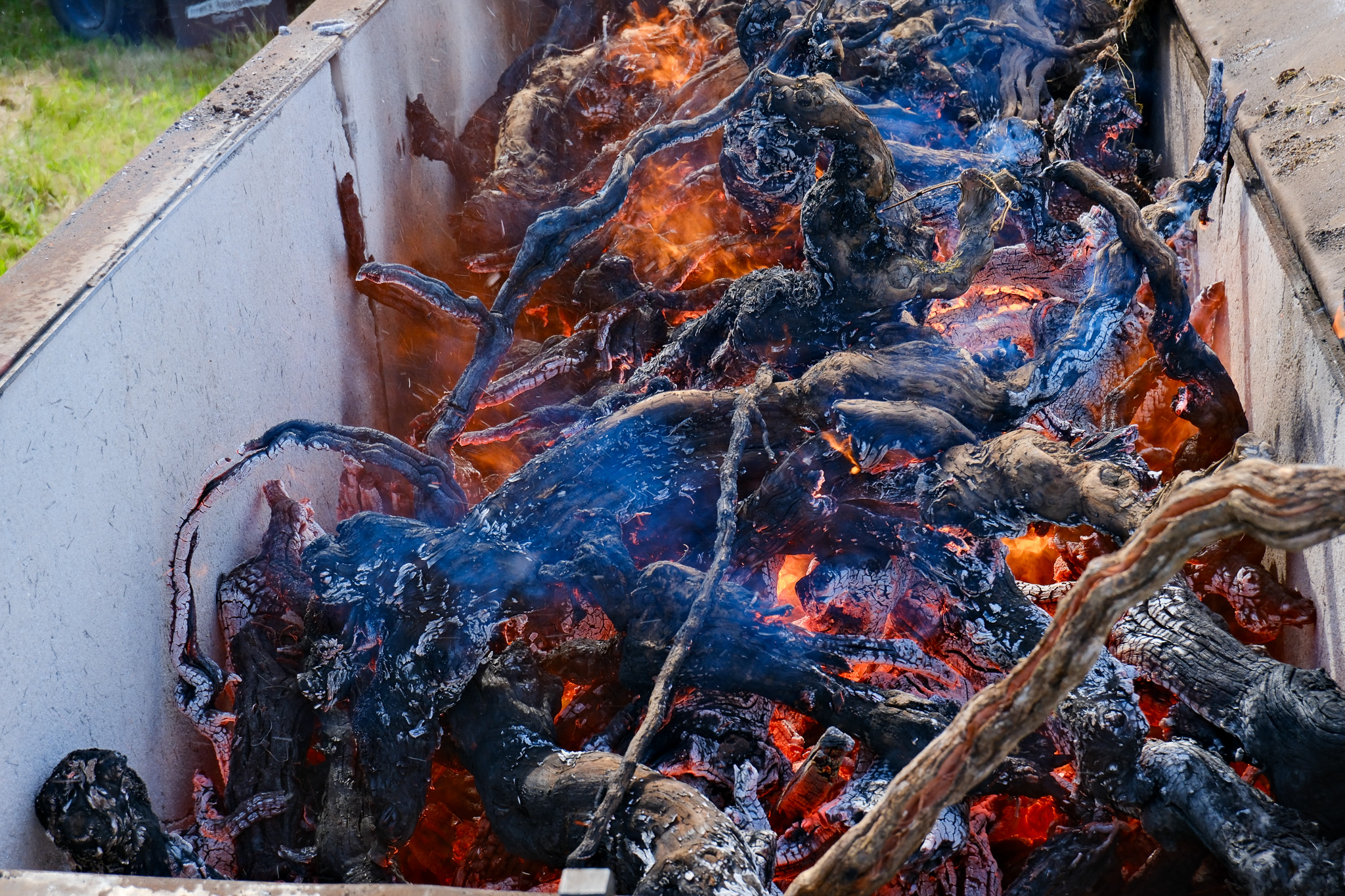
That staying power is the whole point. Burn the wood and the carbon it spent a lifetime pulling out of the sky is back in the air by evening. Turn it into biochar and a good share of that carbon stays put, in a form that doesn't easily break down. It goes into the ground instead of back into the atmosphere.
It also behaves like a sponge once it's in the soil. All those tiny pores give microbes somewhere to live and help the ground hold on to water and nutrients. How much that helps this particular block, we'll find out by watching it.
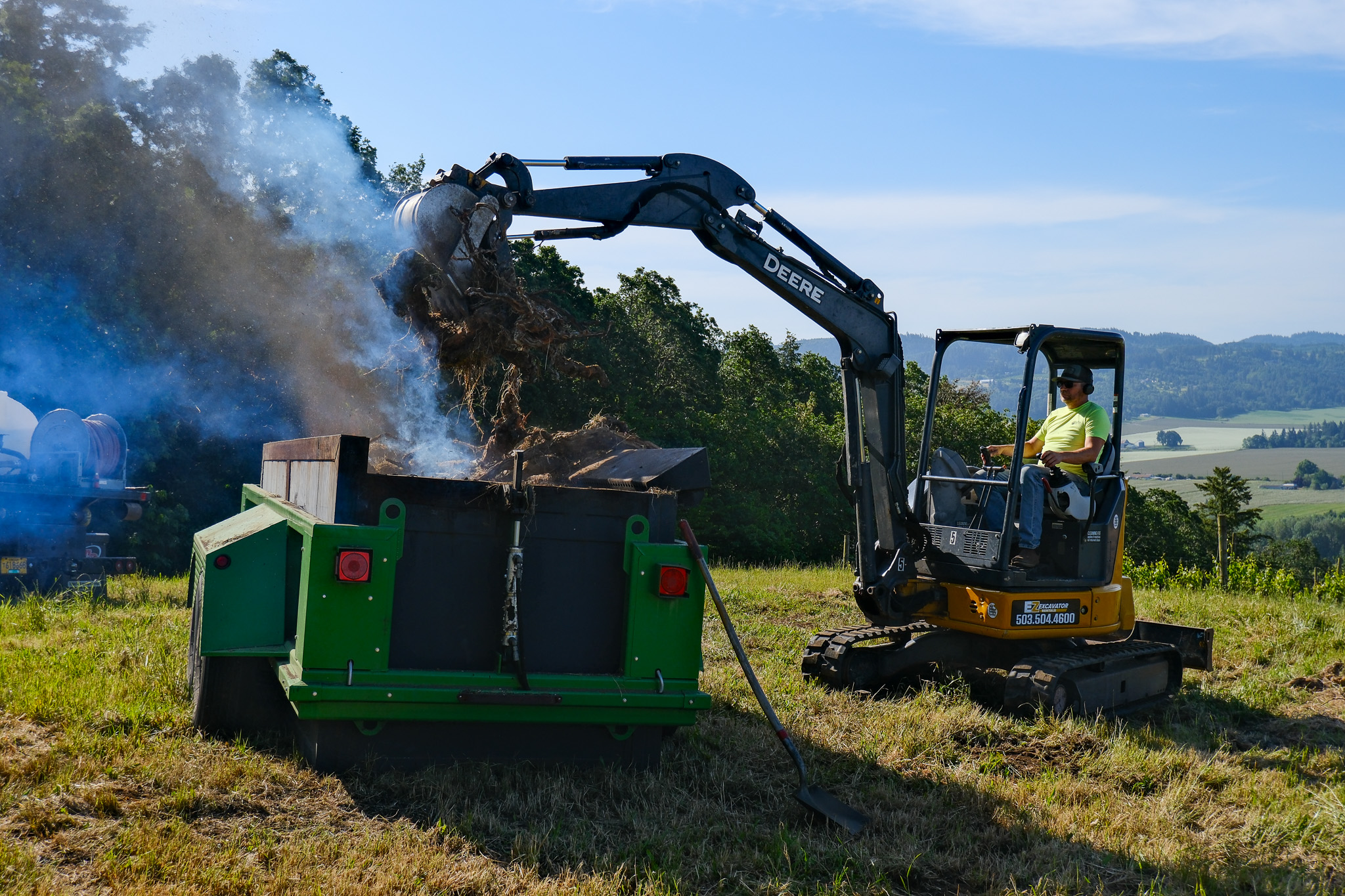
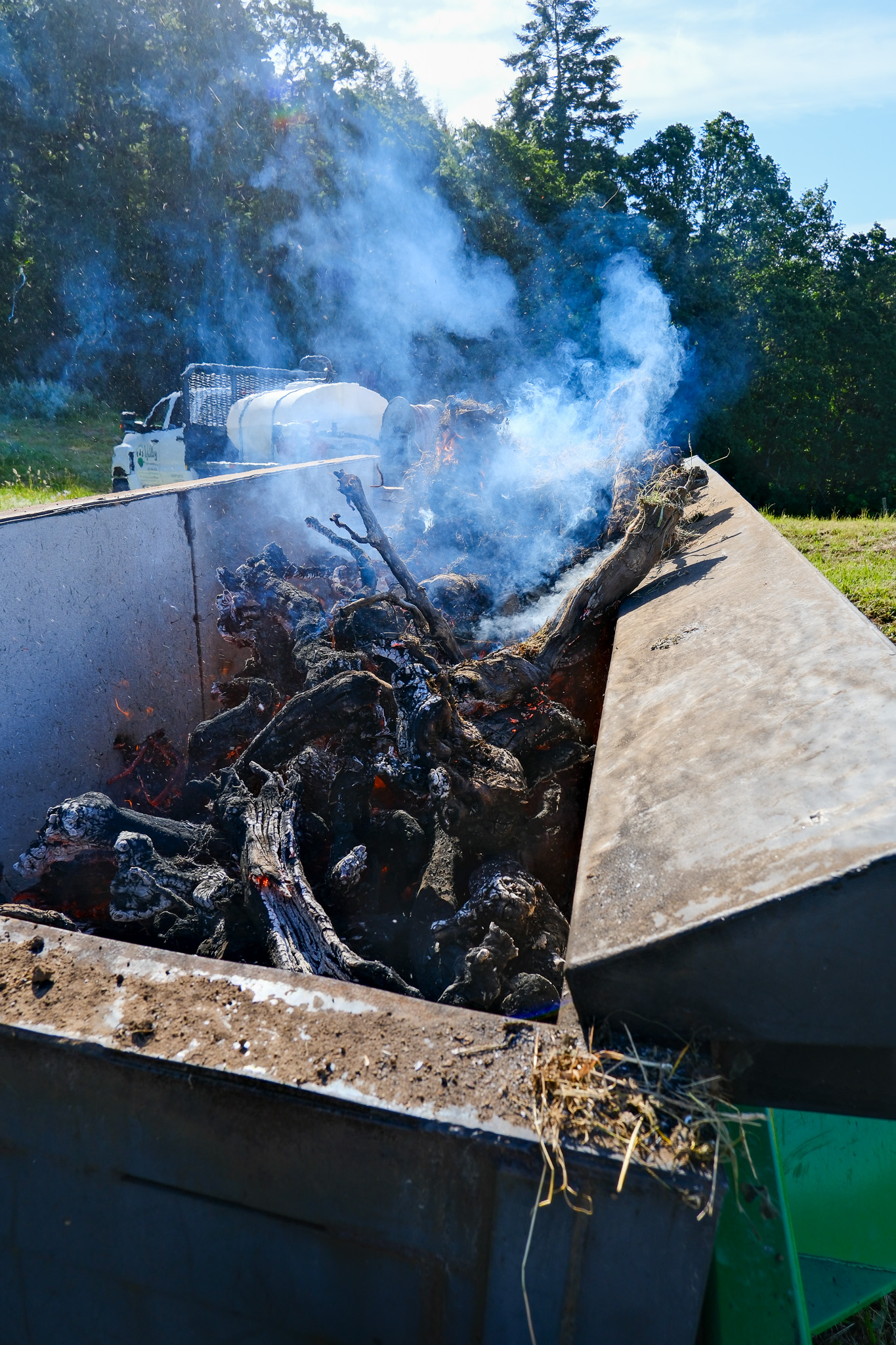
So instead of burning the wood in the open, we made biochar out of it, right there on the property. Valley Environmental hauled in a trailer-mounted curtain burner and we fed the stockpiled trunks through it. It's a neat piece of equipment. A fast curtain of air blows across the top, which keeps the fire hot and pulls the smoke back down into it, so it runs a lot cleaner than an open pile. Down at the bottom of the chamber, the char that forms gets buried and starved of oxygen before it can burn away to ash. You quench it, pull it out, and that's your biochar. In about two hours, a whole block's worth of old trunks came down to a couple of cubic yards of the stuff.
Meanwhile the block itself is getting a full reset. The vines are out, and we've already planted a diverse cover crop to feed the ground while it rests. The biochar is stockpiled and waiting. This fall, when we do site prep, we'll work it in along with compost, so it goes into the soil already charged with nutrients and biology instead of raw. Then another round of cover crop over winter, and the block sits fallow for about a year before we bring it back.
When we replant, it'll be Pinot Blanc again, and not just any Pinot Blanc. We're taking cuttings off the vines we still have on the property, the ones whose fruit we've trusted for years, and grafting them onto phylloxera-resistant rootstock. That way we keep the exact genetics that made this ground worth farming, on roots that can live alongside the pest instead of dying to it. The phylloxera doesn't leave the soil. That's just what replanting an old block means. But vines built this way put up with it, and the biochar and compost we work in first give the young planting a much better start than bare, burned-over ground would.
This story doesn't have a tidy ending, at least not yet.
Once the new vines are in, the thing I'll be watching most is uniformity. A young block is easy to farm when the vines take well and grow evenly, when nearly all of them establish and come up with enough vigor to build good trunks and reach production on roughly the same schedule. Get that right early and everything after it gets simpler. We're hoping the block reaches full production three to five years after we replant. But the real test is longer than that. It's whether this ground gives us the same quality of Pinot Blanc it has for the last fifty years, and whether we've carried Amity's legacy forward instead of letting it slip. That's what success looks like here.

I don't want to oversell any of this. The research on biochar in vineyards is honestly all over the place. Some sites get real gains in vine health and yield, others get almost nothing, and a lot of it comes down to soil and climate. The strongest results show up in warm, sandy, dry soils. Cooler ground like ours tends to respond more slowly. Trials here in Oregon have seen the soil improve within a season, while any payoff in the vines themselves takes longer to show up. Raw biochar can even tie up nitrogen in its first year if you put it down uncharged, which is exactly why we're mixing ours with compost first. How you prepare it matters as much as whether you use it at all. Biochar isn't a fix on its own. It's one piece of a bigger approach to soil health. But as a way to close the loop, to let an old block put something back into the ground it came out of, it felt like the right thing to do.
Every vineyard eventually has to decide what to do with a block that can't be saved. What we did cost more time and money than lighting a match would have. But it felt worth asking whether the wood coming off our land could give something back before it was gone.
These particular trunks won't make another vintage. They've become char, and the char is going back into the ground they grew in. But the vines aren't really gone. The cuttings we took carry their genetics into the new planting, and the carbon they spent a lifetime pulling out of the air stays in the soil the young vines will root into. What came out of this block and what goes back into it are, in the end, the same vines.
And this block is just the start. Over the next several years we'll redevelop the whole original vineyard Myron planted back in the early seventies, block by block, on our own schedule, leaving the ground in better shape than we found it before the new vines go in. Amity has always thought in decades rather than seasons, and this is one of the places you can actually see it.

.png)